
The smell that workbenches are made of.
As I have made my way around the blogging world since December, I have to tell you, the folks in this community are pretty top notch. I am so happy that all of us, though we might be brand loyal in our hearts, support each other no matter the subject. It’s a pretty great place to share.
Just a lead-in to let you know that I’m adding a new category entitled: Owner’s Guides. (Shh…it’s all about Chevy’s, so far). I revisited a stack of car manuals, rich with history, that belonged to my father, great shape and extremely well and very differently written than those of today. I wonder why things aren’t as well written today. Heck, I just bought a new Canon Power Shot camera. Opened the box…no manual. They tell me it’s because things change too quickly. Which makes me wonder why “New” is never as good as the “New and Improved” that will be introduced in 6 months.
All of the guides are from Chevy products:
- 1934 Chevrolet Motor Cars
- Guide to Your New 1953
- 1962 Passenger Car
- 1963 Corvette
- 1965 Chevelle
- 1965 Truck, Series 10-30
- 1966 Chevy II
So I dedicate this and future Owner’s Guide posts to my father who was our original Chevy guy, and my mother, who has carried on our family loyalty to the Chevy brand.
1934 Motor Cars, Master Series DA, Passenger Models, 72 Pages…
This is of course the most weathered of the bunch, but not as you would imagine. It doesn’t have a musty smell, but one of motor oil. The smell that lingers about workbenches and holds garages together. The smell that rises from your hand (no matter how much Goop you’ve used before going into the house so you won’t get into trouble from the wifey). This is a smell that has never bothered a real motor head. A smell that mixes with the taste of a cold beer at the end of a long day on the driveway.
Pages and staples are all in tact. One stain on the front.
The Chevy Bowtie logo is very discreet in the upper left hand corner, a bit different from our present-day commercial riddled world.
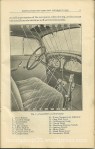
1934 Interior
This is how the Protection Plan reads:
“Any Chevrolet Owner experiencing defective workmanship or material on a Chevrolet car under the terms of Chevrolet’s Standard Warranty is invited to call on any authorized Chevrolet dealer in the United States or Canada where the work will be done at no cost to him.”
Page 7 indicates that there were 9 factories in the US. Flint Michigan boasts the only original factory that I could find.
Page 8 tells me that the 1934 was a straight 6 cylinder with 26.3 horsepower.
On Page 9 I found this awesome bit of advice: “A new car should not be driven faster than 30 miles per hour, for the first 1000 miles.” Whoah!
Octane Selector on Pages 13 and 14 was very interesting. If only it were that easy!

8 Degrees Advance!
There are 6 rules posted on Page 28 for the 1934 driver in the Manner of Braking. #5 certainly wouldn’t fit in today’s world of the hurried motorist, the unobservant cell phone user, and those gifted in the art of drifting. It reads: “A skillful driver never de-clutches his motor until the last moment as the compression, of the engine, on closed throttle materially helps to slow down and stabilize the car when stopping”.
Page 39 Ethyl Gas: “Our experience with Ethyl gasoline for the past few years indicates that it is a satisfactory fuel for use in Chevrolet cars.” I would certainly have cranked my selector to 8 degrees advance! Cooling System: “…kept full of clean water…it is not a good plan to put anti-leak compounds, corn meal, bran or other substances in a radiator, to stop a leak.” The guide at this time even provides directions on making your own ‘Anti-Freezing’ solutions.
Page 45 Spark Plugs: “…designed and made expressly for this engine by the AC spark Plug Company…should be set at .032 inches…AC type K-10…changed every 10,000 miles.”
Chapter 4 spends 11 whole pages on Lubrication, and Chapter 5 wraps up the manual by discussing the care of “a Body by Fisher…with a Duco Finish”. “The Duco finish on a motor car possesses the merit of improving with age, at least, for several months, if the car is properly cared for and not subjected, unduly, to the elements. An occasional polishing with Genuine Chevrolet Polish will restore the luster of the finish. Never use Furniture Polish (can you imagine!?)“.
My father was born in 1939, and never owned a 1934 Chevy so his father may have passed on the manual to him.

What a great feeling knowing that I have kept these manuals over the years. I must have gathered them up from one of the workbenches or the bottom drawer of that big, red Craftsman tool chest in our garage after my dad died. Over the past 33 years I have bumped and landed in many places, always taking with me the box marked ‘Dad/Papers’. So glad to have found these old manuals in that tattered box. Little did my dad know that my 18 years with him were enough to gain my very own ‘guide to life’. Not one word written, no pages dog-eared, and no worn cover. Just a heart filled with guidance, how-tos, and tips to make it in this world. Thanks, Dad!

 This is my favorite plate to date for its cleverness. Good friend and follower Kathy P and I were out shopping one day and came across this in the parking lot of Bed Bath and Beyond. The ‘beyond’ part seems appropriate… You can see right through this guy…he loves his Infinity- proven by the plate frame that repeats the make just inches above. So am I seeing double or did I just see a ….?










 He’s a pretty amazing kid.

 hoodscoop03.com